
It's here, yo
EN-Twitter
Institutional Uses of Twitter
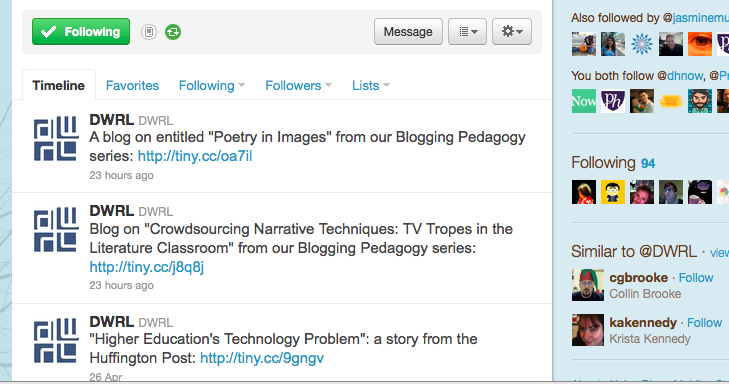
In ruminating on the institutional uses of Twitter and in attempting to decide how the DWRL should manage its own Twitter account, it is important to remember that this tool of social media is inherently a personal one that thrives on a crafted persona. Over time, the stream of tweets reflects a history of the institution and forms an identity. Currently, the DWRL uses Twitter for three reasons: 1) to share the lesson plans and blogs of instructors 2) to participate in the virtual conversation on digital pedagogy 3) to inform followers of events sponsored by the lab.
The DWRL should continue to use Twitter for public relations purposes and should strive to cultivate an ethos of individuality that conforms to the spirit of Twitter. Developing and managing a successful Twitter account will depend on negotiating the tension between the personal and the institutional.
To help determine how the DWRL should craft its Twitter persona, let us consider the possible types of Twitter profiles. In the blog “From Corporate to Personal: A Breakdown of the Four Types of Twitter Profiles,” Jeremiah Owyang suggests that there are four types of Twitter profiles. He gives examples of each type, and he analyzes some of the pros and cons of each type. I quote his schema in its entirety below:
1) Pure Corporate Brand: 100% corporate branded with primarily corporate related content. These accounts, which are often sporting the proper brand name of a company, are used often to provide corporate news, deals, and support. There is no indicator of any individuals involved.
Example: Four Seasons corporate or McAfee News feed which indicates it’s not an interactive feed.
Pros: This account can be managed by a team, and less risk of an individual being co-branded with the brand, as they may leave later.
Cons: This may be perceived as a just an extension of corporate PR or the corporate website with little human interaction.
2) Corporate With Persona: Estimated with about 80% corporate brand and 20% personal brand this account may be a corporate branded account, although it’s clear there’s an individual participating.
Example: ComcastCares, which shows the account is run by Frank Elliason, or CiscoNews, by John Earnhardt
Pros: This account maintains the face of the corporate side, yet shows a human element, building trust with the community.
Cons: The account may be limiting itself as the community may come to expect and rely on the individual person to participate.
3) Employee With Corporate Association:
In a rough estimate this account consists of 20% corporate related content, and approximately 80% personal information. Perhaps the most common account are the thousands or maybe millions of accounts my employees that may not explicitly represent a brand –but they represent their individualism and often indicate they’re an employee of a company.
Example: Take any personal account, which often indicates their name, they indicate they’re an employee, although may have disclaimers that their opinions are theirs alone. Bert Dumars of Rubbermaid.
Pros: These personal accounts are often organic and are a great way to build connections with a community.
Cons: Even if a disclaimer states that “these opinions only represent me, not my employer” they still are representatives of the brand.
4) Pure Personal Account: These accounts are 100% personal content and have no tie or mention of corporate or branded information. These personal accounts, either created by an individual that doesn’t want to be associated with their employer –or their employer won’t let them is void of any corporate ties.
Example: There are various personal accounts, without any affiliations to brands.
Pros: This account has no tie or risk to a brand.
Cons: Although the risks are reduced, so are the opportunities. The chance to evangelize the brand with their community are lost. (“From Corporate to Personal: A Breakdown Of The Four Types of Twitter Profiles”)
Since this is typology for generic institutions, we must consider how Twitter is presently being used in the university and how those uses can be tailored to meet the objectives of the DWRL. Thus, let us look at some studies on the uses of Twitter by universities.
Twitter in the University
These studies attempt to summarize and analyze how universities use Twitter to communicate with the outside world. “Institutional Use of Twitter by Russell Group Universities in the UK” is a study of 20 universities in the United Kingdom that use Twitter in some capacity. The authors found that these institutions used the technology to divulge official news to the outside world, such as news on changes in the administration, safety alerts, school policies, etc. The authors also showed that these schools used the technology to disseminate news on events taking place on school grounds or in affiliation with the school. This included information about lectures, athletic events, etc. Finally, the study showed that universities used Twitter for marketing purposes, where the technology was used to recruit students and to maintain a positive image of the school in the virtual and real world alike.
Given the flexible nature of Twitter technology, this study emphasized that an institution of higher learning ought to craft an appropriate profile, which clearly states the status and purpose of the Twitter account, as well as its scope of usage. Generally, this study focused tremendously on the use of Twitter as means for the dissemination of information; thus, it disregarded the “conversational” nature of the technology and how universities (even as official bodies) participate in a conversation or act as a forum for dialogues.
The study assumed that a university would use Twitter to speak as a single body or institution. The study did not explore the ways that different departments, centers and labs under the aegis of a university might use the software. Given Owyang’s typology, the authors would seem to suggest a “pure corporate brand” for a university.
Since the DWRL operates under the University of Texas and operates as part of the Department of Rhetoric and Writing, its Twitter account should represent the University of Texas while acting as a pioneer organization in the area of digital pedagogy. To balance these two sets of concerns, I would recommend that the DWRL adopt a “Corporate With Persona” profile on Twitter.
What does a “Corporate with Persona” profile mean for the DWRL?
The DWRL has a set of corporate concerns, some of which are expressed through Twitter. For example, the DWRL uses its Twitter account to divulge news and information about events that occur under its auspices. It also uses Twitter as a way to link followers with the work that is being done by the project groups and instructors found on the DWRL website. Finally, it allows DWRL instructors to share their works, such as lesson plans and blogs, with those who follow the DWRL account on Twitter. The DWRL Twitter account should continue to be used for these purposes. However, we cannot say that the DWRL participates in a conversation per se when it uses Twitter in this way; it is not voicing an opinion or responding to other tweets.
The DWRL could make strides in its dialogue with organizations that share its interest in digital pedagogy. This conversation could help the DWRL reap tremendous benefits. First, as Twitter is intrinsically a personal social networking program and because tweets are meant to display a level of spontaneity, it would benefit the DWRL to have some tweeting activity that more directly follows the ethos of Twitter. It would show that the DWRL is in tune with the spirit of individuality at the heart of Twitter. The DWRL would also benefit from the sharing of information that would occur from maintaining such a dialogue and remain à la page with ideas that have yet to find themselves into publications. At the moment, it is difficult for the DWRL to participate in a conversation because one administrator has the responsibility of managing the account and of gathering all the information that becomes tweeted.
The possibilities for cultivating a “persona” profile can be endless. The easiest way to cultivate this persona could be for DWRL instructors to tweet individually, yet on behalf of the organization as representatives of it.
For example, instructors could tweet about a successful lesson plan, an interesting article in their field of interest, events in the conference circuit, or simply about an idea on pedagogy. Regardless of the content, instructors should have to tweet a minimum number of times per semester: perhaps one tweet per week per instructor. A tweet by instructor could read as follows: “Interesting article from The Chronicle (@chronicle) on teaching with Twitter: http://tiny.cc/fpeju”
The author also recommends that users tweet anywhere between the 2 to 10 times a day so as to maintain a readership with followers. While this may appear like a lot of activity for a single administrator of an institutional account, these numbers are more manageable if a number of individuals tweet on behalf of the DWRL. These instructors should follow Twitter etiquette and not flood the stream with tweets (i.e. no more than two tweets at a time).
Regardless of the type of Twitter profile the DWRL chooses, it is important to follow the advice from the Russell Group study, which suggests that an institution ought to craft an appropriate profile, which clearly states the status and purpose of the Twitter account, as well as its scope of usage. In other words, the emitted tweets should match the stated concern in the profile description.
Crafting such a profile is the first step in cultivating a relationship with the DWRL audience, or in Twitter parlance with its “followers.” In a column from the Journal of the European Association for Health Information and Libraries, the author suggests that users “develop some guidelines on who you will follow, whether you will monitor their tweets, whether/when you will retweet (RT) their tweets and whether you will enter into conversations with them. You may wish to follow members of your institution who are Twitterers and retweet any tweets they write about the institution” (“Using Twitter to Promote your Institution”).
Sources:
1) Institutional Use of Twitter by Russell Group Universities in the UK: http://ukwebfocus.wordpress.com/2011/01/14/institutional-use-of-twitter-by-russell-group-universities/
2) The University of Twitter, UK: A Quick Survey:
http://duncan.hull.name/2010/05/28/unitwit/
3) Guide to Preservation of Web Resources: A Case-study on the Institutional Use of Twitter: http://jiscpowrguide.jiscpress.org/case-study-–-institutional-use-of-twitter/
4) Teaching With Twitter: Not for the Faint of Heart: http://chronicle.com/article/Teaching-With-Twitter-Not-for/49230/
5) Stanford U. Tops New Ranking of Colleges’ Influence via Twitter: http://chronicle.com/blogs/wiredcampus/stanford-u-tops-new-ranking-of-colleges-influence-via-twitter/29091
6) Practical Advice for Teaching with Twitter: http://chronicle.com/blogs/profhacker/practical-advice-for-teaching-with-twitter/26416
7) Using Twitter to Promote your Institution:
http://jeahil.wordpress.com/2009/11/15/using-twitter-to-promote-your-institution/
8) From Corporate to Personal: A Breakdown Of The Four Types of Twitter Profiles: http://www.web-strategist.com/blog/2009/07/30/from-corporate-to-personal-the-four-types-of-social-media-profiles/